
Although Pleasantville appears to be a utopia, where everyone is "pleasant" and every day follows a set routine, it becomes evident as the story unfolds, that this town is clearly lacking in vitality and life. The conflict in this movie centers around the clash between the "colored" main characters and the "grayscale" townspeople in Pleasantville.
David(Maguire) is an avid fan of the TV show, Pleasantville Marathon, which follows the daily lives of the townspeople of Pleasantville. He lives vicariously through this TV show, and his sister often complains that he is borderline obsessed. His wistful dream to live in this utopian society is magically granted on a fateful day. David and his sister, Jennifer, are both transported into the TV show.
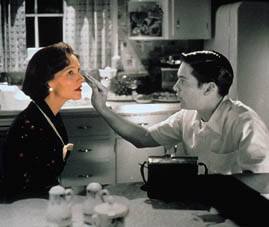
Initially, David is thrilled to be living in his favorite town and show. Jennifer, on the other hand, is less so. However, as the days go by, he realizes that there is something missing in this "perfect" town. Although the people of Pleasantville are consistently happy, their lives are stuck in a monotonous routine. They are unable to feel emotion. They are unable to feel elated happiness or passionate love. Meanwhile, as some of the "grayscale" townspeople interact with David and Jennifer, and are exposed to their experiences in the "real world," they begin to slowly convert to "color."
This phenomenon ultimately leads to the clash between the "coloreds" and the "grayscales." The grayscales are traditionalists who do not want their structured routines to change. Interestingly, the grayscales were dominated by husbands. Husbands who expected their wives to be ubiquitous stay-at-home mothers with no life or personality of their own. The coloreds consisted of mainly wives and teenagers who realized that life had more meaning when there was conflict, and most importantly compromise. They wanted more than just the "safe route." They wanted to truly live.
 A solution to this dystopia is presented in the resolution of the movie. As the town begins to segregate coloreds from grayscales, coloreds are prosecuted and tried for their rebellious actions. When one of the wives presents her side of the story during her trial, her husband begins to understand her feelings. She explains that the coloreds are not trying to let go of the past and start a new, unfamiliar life. They are not trying to abandon their families and loved ones. She still loves her husband, just as she did before. However, she wants him to understand that she is an individual, not simply his wife.
This resolution demonstrates the power of discourse. The segregation and discrimination that occurred in Pleasantville was a result of misunderstandings and ignorance. Upon presenting the views and arguments on each side, the townspeople were able to understand the other side's position and reach an agreement. This type of conflict is common; for as we continue to develop new technological advancements, our mentalities and daily lives evolve and change as well. Older generations thus struggle to keep up with the numerous societal changes that occur in their lifetime. While some may be receptive to these changes, many fight to keep their traditional mindsets and stubbornly reject change. I am not suggesting the abandonment of traditions and the past, but rather discussion and reasoning across generations. This, to me, is the more civilized and diplomatic solution to conflicts and misunderstandings.
This phenomenon ultimately leads to the clash between the "coloreds" and the "grayscales." The grayscales are traditionalists who do not want their structured routines to change. Interestingly, the grayscales were dominated by husbands. Husbands who expected their wives to be ubiquitous stay-at-home mothers with no life or personality of their own. The coloreds consisted of mainly wives and teenagers who realized that life had more meaning when there was conflict, and most importantly compromise. They wanted more than just the "safe route." They wanted to truly live.
This resolution demonstrates the power of discourse. The segregation and discrimination that occurred in Pleasantville was a result of misunderstandings and ignorance. Upon presenting the views and arguments on each side, the townspeople were able to understand the other side's position and reach an agreement. This type of conflict is common; for as we continue to develop new technological advancements, our mentalities and daily lives evolve and change as well. Older generations thus struggle to keep up with the numerous societal changes that occur in their lifetime. While some may be receptive to these changes, many fight to keep their traditional mindsets and stubbornly reject change. I am not suggesting the abandonment of traditions and the past, but rather discussion and reasoning across generations. This, to me, is the more civilized and diplomatic solution to conflicts and misunderstandings.
